The letter lands on your desk late in the day. Your solicitor flags it as urgent. Your finance lead cannot tell you, with confidence, whether the amount claimed is right, whether your records support a defence, or whether the other side has exposed a weakness you have ignored for months.
That is where most businesses encounter the full meaning of a notice of intent. It is not just a legal document. It is the point where a financial problem stops being manageable through emails and meetings, and starts moving on a formal track with deadlines, consequences, and evidence risk.
For directors, owners, and advisers, the danger is rarely the label on the document. The danger is what sits underneath it. Weak ledgers. Unreconciled contract balances. Inflated loss claims. Missing valuation support. Signs of fraud or false billing that no one quantified in time. A Notice of Intent often exposes those weaknesses fast.
A business can still protect itself at that stage. However, speed without financial clarity makes matters worse. Legal advice matters. So does disciplined forensic accounting. If the sums are wrong, if the claim lacks support, or if the company needs to prove distress and preserve value, the numbers decide what works and what collapses under scrutiny.
That Unexpected Letter What Happens Now
A Notice of Intent rarely arrives at a convenient moment. It usually appears when cash is already tight, relationships have soured, or the board suspects something is wrong but has not yet pinned down the figures.
A contractor may receive notice that a payment dispute is going to adjudication. A director of a distressed company may need to file a Notice of Intent to appoint an administrator before creditors escalate. In both situations, people ask the same question first. What does this mean for us today?

Why the first hours matter
The immediate risk is panic. Directors either overreact and concede too much, or underreact and treat the notice as another piece of legal correspondence. Both responses create avoidable damage.
A Notice of Intent signals that someone is moving from informal pressure to formal action. That change forces a business to answer hard questions quickly.
- What is the financial exposure. Not the estimate from memory, but the supportable figure.
- What records prove or undermine the position. Contracts, invoices, payment applications, bank entries, stock records, management accounts, and correspondence all matter.
- Who controls the timeline. In many NOI situations, delay helps the better prepared side.
The emotional reaction usually hides a financial problem
When clients describe the day they first saw an NOI, the legal language is not what unsettled them most. It is the realisation that their own numbers may not be ready for challenge.
That is common in fraud matters, disputed valuations, retention disputes, and insolvency pressures. A company may know something feels off. It may even have a strong commercial case. Yet if the accounting trail is incomplete, the business starts from a weak position.
Tip: The first practical step is not drafting a long reply. It is preserving records, freezing document destruction, and testing whether the figures in play can be evidenced.
Support functions matter too
This is also where process breaks down. Notices get routed slowly. Key attachments sit in inboxes. No one logs deadlines centrally. If your business handles frequent disputes, claims, or compliance-heavy intake, it can help to hire a legal intake specialist so urgent legal and financial documents reach the right people without delay.
That does not replace legal or forensic work. It prevents operational sloppiness from making a difficult problem worse.
What the letter really tells you
At this stage, the document is less important than the shift in posture behind it. The sender is telling you they are prepared to use a process with formal consequences. If you are the sender, you are making the same move and exposing your own evidence to challenge.
That is why a Notice of Intent is a financial inflection point. It can preserve value, unlock payment, support restructuring, or frame a strong claim. It can also crystallise weak assumptions and force a business into a corner if the underlying figures are not defensible.
Decoding the Notice of Intent More Than Just Words
A Notice of Intent is an official warning that a party intends to take a defined next step. That is the simplest notice of intent meaning. In practice, it acts like a starting signal. Once served properly, it can trigger a timetable, change the parties’ rights, and narrow the room for vague argument.
It is not a substitute for the main legal process that follows. It is the document that launches that process.
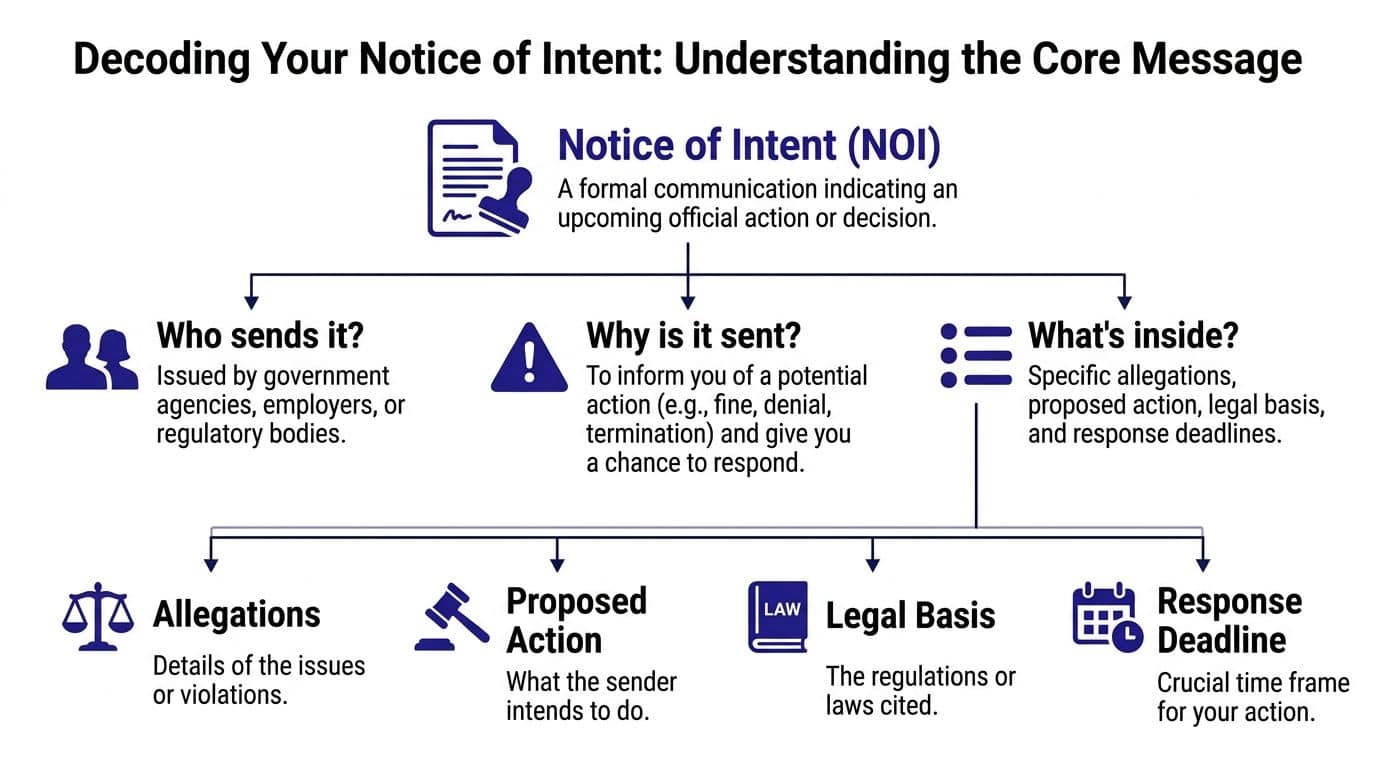
What a valid notice usually needs to do
A strong NOI is precise. It identifies who is involved, what issue has arisen, what action is intended, and what basis supports that action. It also needs to respect the procedure that applies in the relevant context.
That sounds obvious. Yet many weak notices fail because they rely on assertion instead of evidence, or because they treat procedural detail as an afterthought.
A practical reading of an NOI should focus on four points:
The parties
The notice must identify the sender and recipient clearly. Wrong entities, trading names used loosely, or confusion between employer, contractor, group company, or director can create avoidable disputes.
The dispute or event
The notice should define the issue sharply. Broad complaints usually weaken the sender. Specific allegations create pressure, but they also create targets for challenge.
The intended next step
This is the heart of the document. The notice says what the sender plans to do next, such as appoint an administrator or refer a dispute to adjudication.
The legal and factual basis
The stronger notices align the legal route with the accounting record. The weaker ones rely on rhetoric and hope the other side folds.
Later in the process, parties often discover that the legal framing looked adequate but the numbers underneath it did not survive inspection.
The video below gives broader context on the concept before you assess the document in front of you.
Why financial detail belongs in the first review
People often ask solicitors, “Is this valid?” That is the right question, but not the only one. A better pair of questions is, “Is this procedurally valid?” and “Do the figures survive challenge?”
In construction, this matters immediately. Under UK construction law via the Housing Grants, Construction and Regeneration Act 1996, a Notice of Intent to refer a payment dispute to adjudication is a statutory prerequisite. Non-compliance risks jurisdictional challenges, with 22% of referrals dismissed on procedural grounds according to RICS 2024 adjudication statistics.
The legal route may exist, but the financial story still needs to work. If the claimed value depends on unsupported variations, confused retention schedules, or defective cost allocation, the notice may start a process the sender cannot finish well.
Contracts often decide what the notice can achieve
Many NOI disputes start much earlier than the notice itself. They begin in poor drafting, loose approval processes, and inconsistent contract administration. If your dispute sits inside a wider contractual framework, this guide to https://lighthc.london/agreements-and-contracts/ helps explain why disciplined contract structure matters before formal action begins.
Key takeaway: A Notice of Intent is not powerful because it sounds formal. It is powerful because it activates a process. The business with the cleaner records usually gains control of that process.
The Two Arenas Where a Notice of Intent Changes Everything
The phrase notice of intent meaning becomes much clearer when you look at the two UK settings where it regularly alters outcomes. One sits in insolvency. The other sits in construction adjudication. Both involve deadlines. Both involve pressure. Both reward parties who can support their figures.
In insolvency, the notice can protect time and value
A Notice of Intent to appoint an administrator is often the decisive move when a company is under creditor pressure but still has a realistic chance to preserve value.
In UK insolvency law, a Notice of Intent to appoint an administrator enables a 10-business-day moratorium on creditor actions. Evidence from UK Insolvency Service statistics (2023) shows NOIs comprised 28% of all administration appointments, with pre-pack sales via NOI recovering £2.1 billion in asset value across SMEs according to this reference.
That matters because distressed businesses lose value quickly when creditors move first and management loses control of the timetable. Stock can be sold at distressed prices. Customer confidence can collapse. Key staff may leave. Records may become harder to reconstruct.
What directors get wrong in insolvency NOI situations
The common mistake is treating the NOI as a shield on its own. It is only effective when the company can support the underlying position.
That means answering practical questions such as:
- Asset support: Are stock, work in progress, debtors, and plant values current and credible?
- Fraud indicators: Do unexplained losses, suspect payments, or manipulated records need urgent investigation before any sale or restructuring?
- Creditor treatment: Can the business show a rational basis for the path chosen?
A rushed filing without financial discipline can still invite challenge. A properly prepared filing gives directors a protected window to stabilise records, assess viability, and test whether a rescue or pre-pack route is defensible.
In construction, the notice starts a compressed payment battle
Construction uses the NOI differently. Here, the document is the gateway into adjudication on payment disputes. It is less about preserving the company from creditors and more about forcing a fast answer to a cash dispute that can damage the whole project.
Once the notice goes in, the dispute stops being a running argument between commercial teams. It becomes a formal contest over valuation, entitlement, timing, and evidence.
Why numbers decide construction outcomes
Construction adjudication moves quickly. That speed helps businesses who are owed money, but it punishes poor preparation. A claimant needs a coherent schedule of amounts due. A responding party needs a grounded explanation for deductions, contra-charges, defects, or withheld retention.
Forensic accounting becomes practical here, not theoretical.
A forensic accountant can help by:
- Rebuilding the claim logic from applications, certificates, payment notices, contract terms, and ledger entries.
- Testing defect and delay costs to see whether they are evidenced or broad estimates.
- Tracing fraud or falsification concerns where valuations or supporting documents appear manipulated.
The trade-off in construction disputes
The attraction of adjudication is speed. The trade-off is that weak records do not get much time to improve. Businesses that issue an NOI too early can lock themselves into a claim they have not quantified properly. Businesses that ignore a received notice can sleepwalk into a binding decision built on the other side’s version of the numbers.
Tip: In both insolvency and construction, the most dangerous phrase is “we can sort the figures out later”. By the time later arrives, the process may already favour the other side.
Same label, very different consequences
Both documents are called Notices of Intent, but they operate differently.
| Arena | What the NOI does | Financial issue at the centre |
|---|---|---|
| Insolvency | Opens a protected route toward administration | Preserving enterprise value and testing distress thoroughly |
| Construction | Starts the path toward adjudication | Quantifying what is due, withheld, defective, or disputed |
The legal mechanics differ. The core discipline does not. A party gains advantage when it combines procedural accuracy with reliable financial analysis.
Common Missteps and Objections When Handling an NOI
The biggest mistakes around a Notice of Intent are rarely technical at first. They start with assumptions. The director assumes legal counsel will handle everything. The commercial manager assumes the notice is a pressure tactic. The finance team assumes the records are good enough.
Those assumptions produce weak responses.

It is just a formality for solicitors
This is the most common objection. It is also one of the most costly.
Solicitors handle process, drafting, strategy, and legal rights. They do not replace the need for tested numbers. If the notice concerns disputed payments, insolvency distress, fraud, defective works, or loss quantification, the financial record carries much of the case.
A frequently unaddressed issue is the forensic accounting implications of defective Notice of Intent practice in UK construction, where improper NOIs contribute to 28% of adjudication dismissals because they lack quantified evidence of losses or fraud, according to the CIOB 2025 report reference.
That point matters beyond construction. A notice can look formal and still fail because the amount, loss basis, or evidential support does not stand up.
We know our numbers already
Businesses often know their commercial story. That is not the same as having a defensible quantification.
A managing director may say the supplier overbilled. A contractor may insist retention is overdue. A board may believe fraud caused the cash crisis. Those may all be true. However, once an NOI appears, beliefs need to become schedules, reconciliations, transaction trails, and clear adjustments.
What usually fails under scrutiny
- Spreadsheet totals with no source trail
- Round-number loss claims
- Mixing projected losses with actual booked losses
- Relying on draft management accounts that were never reconciled
- Asserting fraud without tracing transactions
A forensic accountant costs too much
This objection sounds sensible until the process starts moving.
The apt comparison is not between spending on expert financial analysis and spending nothing. The apt comparison is between spending early to control the evidence and paying later for a weak case, a poor settlement, or an avoidable defeat.
In insolvency, weak quantification can distort value and creditor outcomes. In construction, poor loss support can undermine jurisdictional and merits positions together. In either context, the cost of bad numbers often exceeds the cost of proper analysis.
Key takeaway: The question is not whether your business can afford financial analysis after a Notice of Intent. The sharper question is whether it can afford to proceed without it.
We should wait and see
Waiting feels safe because it avoids immediate cost and confrontation. It usually benefits the other side.
An NOI compresses time. Delay means records become harder to gather, staff memories weaken, and the other party advances its narrative without challenge. Even where legal deadlines allow a response window, practical preparation time is always shorter than it looks.
The businesses that handle NOIs well do not always win every issue. They do avoid the preventable errors that weaken good positions before the main fight starts.
Turning the Tables with Forensic Accounting Expertise
A Notice of Intent creates pressure. It also creates opportunity. If your side understands the numbers better than the other side, the NOI can become the moment you regain control.
That applies whether you are issuing the notice or receiving it.
When you are preparing the notice
A business should not issue an NOI on instinct. It should issue one on evidence. That means turning a commercial grievance or insolvency concern into a supportable financial position.
Resources often overlook how a Notice of Intent to Appoint an Administrator provides an important window for forensic investigation in fraud cases. That need is highlighted by a 15% rise in NoIA appointments in 2025 and R3 survey data showing 62% of mid-market firms are unprepared for NoIA timelines, as noted in this reference.
That matters because a company in distress often discovers, too late, that losses are not just operational. They may involve false invoicing, hidden related-party transactions, inventory shrinkage, manipulated margins, or payment diversion. A forensic accountant helps separate genuine distress from misconduct and quantify both.
Practical financial work before service
The useful work is rarely glamorous. It is disciplined.
- Reconcile ledgers to underlying documents.
- Trace disputed transactions.
- Distinguish hard loss from estimate.
- Test whether asset values are current.
- Identify where management information conflicts with accounting records.
If the notice is going into a construction dispute, the same discipline applies to interim applications, retention, defects, contra-charges, and supporting valuation material.
For wider litigation support context, this guide explains how forensic input fits into contentious matters: https://lighthc.london/forensic-accounting-in-the-uk-when-its-needed-and-how-it-supports-litigation/
When you have received the notice
Receiving an NOI does not mean accepting the sender’s numbers. It means you now need a structured financial review before the process moves further.
The strongest responses do three things at once. They test the arithmetic, test the assumptions, and test the provenance of the data.
Questions that often provide an advantage
A receiving party should ask:
- Does the claim double count any category?
- Are there unsupported allocations or broad estimates?
- Have costs been included that the contract does not permit?
- Do the books and bank entries match the story in the notice?
- If fraud is alleged, where is the transaction trail?
Many notices look stronger than they are because the recipient focuses on tone instead of evidence.
Tip: A hard-headed review often changes settlement posture quickly. Once unsupported figures are exposed, the commercial balance can shift.
A practical checklist for the first response window
| Step | Action Required | Forensic Accounting Value |
|---|---|---|
| 1 | Secure the notice, attachments, and proof of service | Confirms scope, timeline, and any missing financial schedules |
| 2 | Preserve accounting and operational records | Prevents gaps in ledgers, emails, and source documents |
| 3 | Reconcile core figures | Identifies mismatches between claimed sums and actual records |
| 4 | Test the basis of loss or value | Separates evidenced loss from assumption or advocacy |
| 5 | Review indicators of fraud or manipulation | Exposes unusual transactions, altered support, or false billing patterns |
| 6 | Prepare a response position | Converts accounting findings into a defensible narrative for legal use |
| 7 | Assess expert witness needs | Ensures analysis can withstand scrutiny in negotiation or court |
What works and what does not
What works is disciplined quantification, early record preservation, and close coordination between legal and financial teams.
What does not work is sending broad allegations, relying on internal spreadsheets no one can explain, or assuming the other side cannot test your figures. In NOI disputes, unsupported confidence is a poor substitute for evidence.
From Uncertainty to Action Your Next Move is Critical
A Notice of Intent forces a business to declare where it stands. The document may concern insolvency, payment, fraud, or disputed loss. In every version, the same truth sits underneath it. The legal process matters, but the financial evidence often determines whether the process helps you or harms you.
That defines the practical meaning of a notice of intent for most UK businesses. It is the moment when assumptions stop being enough.
What businesses regret most
They regret waiting. They regret treating the notice as someone else’s problem. They regret discovering too late that the amount in dispute was never properly reconciled, that key records had gone missing, or that a fraud issue should have been investigated long before the NOI arrived.
Good preparation before any dispute helps. For teams tightening controls upstream, these contract management best practices are a useful operational reference because many NOI problems begin with weak documentation, poor approval discipline, and inconsistent record keeping.
What to do now
If you have received an NOI, gather the documents, fix the internal reporting line, and test the numbers immediately.
If you are planning to issue one, do not rely on assertion. Build the evidence first. A notice supported by clear financial analysis has far more strategic value than one built on pressure alone.
For businesses that need stronger dispute records and evidential discipline, this resource on https://lighthc.london/documentation-in-dispute-resolution/ is a useful starting point.
Key takeaway: Speed matters after a Notice of Intent. Accuracy matters more. The best outcomes usually go to the party that combines both.
The period after an NOI does not need to be chaotic. It needs structure. Once the numbers are tested properly, management can decide whether to challenge, settle, restructure, or escalate with confidence rather than guesswork.
If you are dealing with a Notice of Intent, or considering issuing one, Lighthouse Consultants can help you quantify losses, test the other side’s figures, investigate fraud indicators, and prepare reporting that stands up in negotiation and litigation. Start with a free discovery call and get a clear action plan before the timeline tightens.
Tags: forensic accountant, forensic accounting