Your finance director says trading is steady, yet cash feels permanently tight. A supplier query turns into a procurement concern. Then a shareholder asks for records you cannot pull together quickly. At that point, most firms do not have a growth problem. They have an evidence problem.
That is where business advisory services stop being a nice-to-have and start becoming operational protection. In practice, the most valuable advisory work is often not broad strategy. It is targeted forensic accounting, risk review, claim quantification, and due diligence that tells you what happened, what it cost, and what you can prove.
The Unseen Cracks in Your Business Foundation
A business rarely tips into crisis all at once. The warning signs usually arrive in fragments.
Margins slip without a clear operational reason. A trusted manager resists document requests. Stock losses keep appearing, but no one can tie them to one control failure. A legal dispute begins with a “small commercial disagreement” and then grows into an argument about causation, loss, and credibility.

For many directors, the first instinct is to contain cost. They ask whether their regular accountant can handle it, whether legal counsel can “work it out”, or whether an internal review will do. That reaction is understandable. It is also where avoidable losses often deepen.
According to the UK Finance annual fraud report 2024, SMEs in the UK lost £1.17 billion to fraud in 2024, 57% reported incidents, but only 37% sought professional help. That gap matters. Businesses often delay specialist input until documents have gone missing, narratives have hardened, and counterparties have shaped the record first.
Why general accounting is not enough
Routine accounting work keeps a business compliant. It does not automatically test whether transactions are manipulated, whether losses are recoverable, or whether evidence will survive challenge from solicitors, insurers, regulators, or opposing experts.
A standard finance process usually answers questions such as:
- What was booked: ledger entries, invoices, payroll, VAT, and year-end treatment
- What is due: tax compliance, reporting deadlines, reconciliations
- What changed: variances, trends, and management accounts
A forensic accounting engagement answers different questions:
- What occurred: who did what, when, and through which transactions
- What can be evidenced: source records, data trails, inconsistencies, and control failures
- What is the financial impact: quantified loss, business interruption, overstatement, or hidden liability
The cost objection often points in the wrong direction
Many owners treat specialist advisory as an expensive escalation. In reality, delay is often what makes a situation expensive.
If fraud sits untested, staff continue using the same weak process. If a dispute reaches formal proceedings without sound quantification, lawyers spend time arguing around incomplete numbers. If an acquisition proceeds on headline figures alone, a buyer can inherit problems that should have been identified before signing.
Practical view: the cheapest route is rarely the one with the lowest fee at the start. It is usually the route that gets to reliable facts fastest.
What works and what fails
The firms that regain control do a few things quickly. They preserve records, restrict internal speculation, define the exact financial question, and bring in a specialist who knows how to investigate and quantify.
What fails is equally predictable.
| Approach | What usually happens |
|---|---|
| Internal review with no scope | Too many opinions, not enough evidence |
| Early accusations without proof | Employees lawyer up and records become harder to secure |
| Legal action before quantification | Costs rise while core loss questions stay unresolved |
| Reliance on headline accounts | The underlying transaction trail remains untested |
The hard truth is simple. A hidden financial problem does not stay administrative for long. It becomes legal, commercial, and personal very quickly.
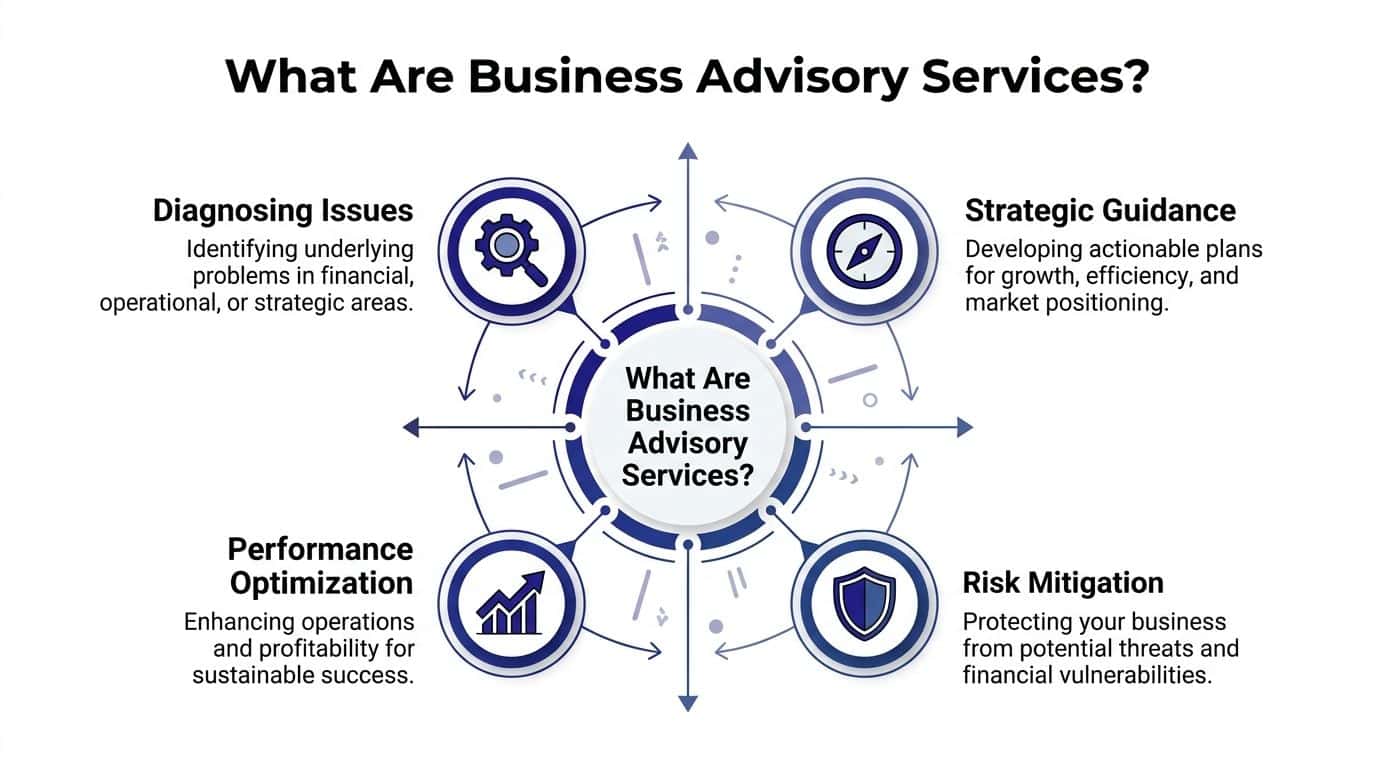
What Are Business Advisory Services Really
Many people hear “business advisory services” and think of strategy decks, growth plans, or periodic boardroom support. Those things exist. They are only part of the picture.
In serious situations, business advisory services mean specialist financial problem-solving. The best comparison is medical. Your regular accountant is your GP. They manage routine financial health, compliance, and reporting. A forensic accountant or specialist advisor is the surgeon. They step in when the issue is complex, time-sensitive, and potentially damaging.
The UK business base explains why this matters. UK government business population estimates for 2024 show that SMEs account for 99.9% of private sector businesses and generate £2.4 trillion in turnover. The same verified data set also notes that a 2023 ICAEW report found 52% of mid-sized firms experienced economic crime, with median losses of £250,000. That combination creates a straightforward reality. Smaller and mid-market firms carry material financial risk, yet many do not have in-house forensic capacity.
The Dividing Line
Traditional accounting is mainly backward-looking and compliance-led. Advisory work is decision-led. Forensic advisory work is evidence-led.
That distinction matters because different business problems require different disciplines.
| Need | Typical accounting response | Specialist advisory response |
|---|---|---|
| Tax filing and accounts prep | Prepare and submit | Limited unless a dispute exists |
| Cash flow pressure | Report balances | Diagnose causes and test leakage |
| Suspected fraud | Flag anomalies | Investigate records and quantify losses |
| Acquisition target review | Review headline numbers | Challenge assumptions and identify hidden liabilities |
| Litigation support | Provide documents | Build court-ready quantum analysis |
Good advisory work is specific
Useful advice is rarely broad. It should tell management what to do next, what evidence matters, and where the risk sits if they do nothing.
For one company, that might mean tracing irregular payments through supplier accounts. For another, it means assessing whether a business interruption claim is defensible. In a transaction, it may mean recalculating earnings quality rather than accepting adjusted EBITDA at face value.
Businesses also need outside specialists in adjacent disciplines. Commercial growth, for example, may require expertise far beyond finance. If your problem is demand generation rather than loss quantification, this guide on marketing consultancy drives ROI for your SME is a useful contrast because it shows where marketing advice fits and where financial investigation is the better tool.
Where forensic accounting fits
Forensic accounting sits inside business advisory services, but it serves a sharper purpose. It deals with matters where the facts may be disputed, the losses may need formal quantification, and the output must withstand scrutiny.
That includes:
- Fraud investigations: tracing payments, testing vendor relationships, examining journals and exception patterns
- Dispute support: calculating damages, lost profits, diverted business, or shareholder prejudice
- Insurance work: quantifying interruption losses and testing assumptions
- Transaction support: challenging earnings adjustments and uncovering contingent exposures
- Control reviews: identifying how the failure happened and how to stop it recurring
For a broader strategic context on where specialist advisors fit into leadership decisions, this perspective on why you need a strategic business consultant adds another angle.
Key takeaway: business advisory services are not one service. They are a set of specialist interventions designed to solve financial problems that routine finance work cannot resolve on its own.
Your Toolkit for Financial Investigation and Defence
When financial pressure turns adversarial, businesses need more than commentary. They need tools. Not generic ones either. They need methods that can test facts, isolate loss, and hold up when another side challenges every assumption.

Forensic accounting when the numbers do not make sense
Forensic accounting services come into their own when management knows something is wrong but cannot yet prove what, where, or how much. The work usually starts with data preservation, document review, ledger extraction, control mapping, and targeted interviews.
The most effective forensic reviews do not begin by trying to prove a theory. They begin by testing the transaction trail. That means looking at journals, supplier master file changes, duplicate or split payments, suspicious credit notes, round-sum entries, unusual timing, and relationships between staff, vendors, and bank activity.
The technical side matters. Verified data notes that forensic accounting methods such as Benford’s Law analysis can detect 70-80% of fabricated financial data, and that in UK economic crime proceedings, expert reports from Chartered Management Accountants have reduced settlement times by 40% and increased claimant awards by 15-20% according to the referenced source at Sterling Cooper Consultants.
That does not mean software replaces judgement. It does not. Benford’s Law is a screening tool, not a conclusion. Pattern analysis can flag anomalies, but an expert still has to connect the accounting pattern to actual conduct, actual controls, and actual loss.
Due diligence before you inherit somebody else’s problem
Good due diligence is not a box-tick. It is a sceptical review of what the seller says the business is worth and what the records demonstrate.
In practice, the most useful due diligence work often happens in three layers:
Quality of earnings
Test whether reported profits come from normal trading or from one-off items, timing distortions, aggressive revenue treatment, or unusual capitalisation.Balance sheet exposures
Look beyond debt. Check aged receivables, stock reliability, supplier dependencies, contingent claims, and tax-sensitive positions.Behavioural warning signs
Late data room uploads, unexplained manual journals, resistance to customer concentration analysis, and over-reliance on management-adjusted metrics all deserve attention.
Risk reviews and internal audits before a problem matures
Many crises begin as boring weaknesses. One person can set up a supplier, approve invoices, and reconcile the account. Stock adjustments go through without challenge. Credit control logs do not match the sales ledger narrative. These are not dramatic failures until money disappears or a claim lands.
A practical risk and internal audit review asks:
- Where can one person act without review
- Which controls exist only on paper
- Which reconciliations are late, weak, or not independently checked
- Which exception reports management never reads
- How quickly can the business retrieve evidence if challenged
Tip: if a business cannot assemble the underlying records for a disputed issue quickly, it already has a control problem, even before anyone proves misconduct.
For readers weighing formal investigation against narrower diagnostic work, this explanation of an evidence-first approach to fraud and disputes is useful because it focuses on how specialist forensic accounting services are structured in practice.
Dispute quantification for law firms and commercial parties
Not every financial conflict is fraud. Many are disputes about contract breach, diverted opportunities, shareholder conduct, delayed projects, defective performance, or business interruption.
In those matters, the question is not only “who is right?” It is “what is the measurable loss, what assumptions are reasonable, and how do you show causation?” That is where a weak schedule of loss often damages a strong legal position.
A sound quantification exercise usually separates:
| Question | Why it matters |
|---|---|
| What event caused the loss | Prevents over-claiming and weak causation |
| What period should be measured | Stops distortion from unrelated trading changes |
| What baseline is fair | Uses actual records, not wishful budgeting |
| What costs were saved | Avoids inflated net loss claims |
| What evidence supports mitigation | Shows the claimant acted commercially |
Later in the matter, parties can argue methodology. They will. But that argument is manageable if the foundational records are organised and the model is defensible.
A short explainer is useful here before moving on:
Sustainability and compliance reviews
Not all advisory work starts with a dispute. Some of the best work prevents one. Sustainability audits, compliance reviews, and governance testing can expose reporting gaps before a regulator, investor, or acquirer does.
That work matters because modern financial disputes increasingly overlap with disclosure quality, internal governance, and documentary integrity. If management statements cannot be reconciled to operational records, credibility erodes fast.
The common thread across all these services is the same. Good business advisory services do not merely describe risk. They convert uncertainty into evidence, options, and action.
How Different Stakeholders Gain a Winning Edge
Different stakeholders hire the same advisory team for different reasons. The mistake is to describe the value in one generic way. A managing director, a litigation partner, and an insurer do not buy the same outcome, even when they use similar forensic accounting services.
SME owners and finance leaders
For owners and CFOs, the first objective is usually control. They want to know where the money went, whether they can recover it, and how to stop the issue repeating.
The practical gains are immediate. A focused forensic review gives management a chronology, identifies the records that matter, and avoids random internal blame. That alone can stabilise a business that is losing time to rumour and rework.
The wider advantage is decision quality. Once the financial position is grounded in evidence, directors can decide whether to negotiate, litigate, report, settle, discipline, or redesign controls.
Law firms and litigators
Solicitors need more than large bundles and forceful allegations. They need financial analysis that survives scrutiny.
A strong forensic accounting report helps legal teams in three ways. It narrows issues, supports settlement discussions, and performs under cross-examination because the numbers reconcile to source material rather than advocacy. That reduces wasted argument around weak schedules and undocumented assumptions.
Litigation reality: courts and counterparties do not reward volume. They reward coherent evidence, disciplined methodology, and a loss model that can be explained line by line.
Insurers and claims handlers
Insurers need fair quantification, not inflated narratives. In business interruption, fidelity, or fraud-related matters, the challenge is often separating genuine loss from poor records, optimistic forecasting, or unrelated trading decline.
Independent forensic analysis helps by testing turnover trends, saved costs, mitigation efforts, and documentary support. It also gives claims teams a clear basis for challenge when assumptions drift away from the policy or the evidence.
Investors and boards
Investors and boards focus on downside protection. In transactions or distressed situations, they need to know whether reported performance is real, whether liabilities are understated, and whether management information can be trusted.
Verified data from Portage Point Partners states that 28% of mid-market M&A deals suffer post-completion value erosion over 15% due to undetected financial issues, while expert due diligence reduces overpayment risks by 35% and can increase deal completion rates by 22%. Those figures explain why discerning buyers do not rely on headline management presentations alone.
A quick stakeholder view
| Stakeholder | What they want most | Where advisory adds the edge |
|---|---|---|
| SME owner | Recovery and stability | Fraud tracing, control fixes, cash impact analysis |
| CFO | Clear decision base | Quantified loss, evidence packs, scenario testing |
| Law firm | Stronger case support | Independent expert analysis and quantum modelling |
| Insurer | Fair settlement position | Claim testing, BI analysis, document challenge |
| Investor or board | Risk visibility | Due diligence, earnings quality, hidden liability review |
For organisations trying to align management, compliance, and legal accountability, this discussion of internal stakeholders roles responsibilities and legal risk in UK businesses is worth reading because it frames how financial issues spread across the business once controls fail.
Choosing the Right Expert Navigating Your Options
Not all advisory firms are built for high-stakes work. Some are excellent at planning, forecasting, and general commercial support. Others can investigate, quantify, report independently, and appear in contentious settings. If your issue may end up in a disciplinary process, formal claim, or court timetable, that distinction matters.

What to check before you appoint anyone
Start with credentials, but do not stop there. Chartered status matters because it signals technical training and professional discipline. Yet credentials alone do not prove that a team can handle a fraud investigation, a business interruption claim, or a disputed valuation under pressure.
Check for these points:
- Relevant forensic experience: not just accounts preparation or general consulting
- Sector familiarity: retail, logistics, aviation, manufacturing, insurance, or whichever context your matter sits in
- Report quality: can they produce clear, evidenced work that a non-financial audience can follow
- Litigation awareness: do they understand disclosure, independence, causation, and challenge
- Structured process: do they define scope, outputs, assumptions, and timetable early
Red flags that usually lead to trouble
Poor appointments often look attractive at the start. The fee estimate is low, the promises are broad, and the methodology sounds impressive but vague. Then the gaps appear.
Watch for these warning signs:
| Red flag | Why it matters |
|---|---|
| Vague proposal language | Suggests the work is not properly scoped |
| No clear evidence protocol | Risks contamination, delay, or missed records |
| Heavy jargon, little clarity | Often hides weak thinking |
| No contentious matter experience | Problem if the report faces legal challenge |
| Immediate conclusions before review | Suggests advocacy, not analysis |
Good process beats dramatic claims
A reliable advisory engagement is usually calm and methodical. It starts with a focused discovery conversation. Then it narrows the issues, sets a workable scope, identifies priority documents, and agrees what the output needs to achieve.
That approach serves clients far better than a sprawling review with no defined question. In difficult matters, clarity is a commercial advantage. It controls cost, protects management time, and keeps the work tied to decisions.
Practical buying rule: ask what the firm needs in the first week, what it will test first, and what a usable output looks like. If the answers are vague, keep looking.
Trade-offs you should weigh
There is no perfect appointment. Every client balances urgency, cost, depth, and the likely destination of the matter.
A lean review may suit an early internal concern where management wants to decide whether escalation is necessary. A fuller forensic investigation may be essential if the issue already affects insurers, funders, regulators, or external counsel. The right answer depends on what you need to prove, not just what you hope to spend.
Good advisors will say that plainly. They will also tell you when a narrow scope is false economy. That candour is usually a sign you are dealing with serious practitioners rather than sales-led generalists.
Business Advisory Services in Action
Theory is useful. Pressure-tested examples are better.
The value of business advisory services becomes obvious when a business faces a live financial problem and needs a defensible answer quickly. The pattern is consistent across sectors. Facts first. Quantification second. Decisions third.
Procurement concerns inside a retail business
A retail management team noticed margin pressure that routine reporting could not explain. Stock movement looked untidy, but the bigger issue sat in purchasing. Supplier pricing varied in ways that did not match contracts, and credit notes appeared inconsistent across locations.
The investigation focused on supplier files, purchase ordering behaviour, invoice sequencing, and approval patterns. That type of forensic accounting work usually reveals whether the issue is sloppiness, control weakness, or something more deliberate. Once the transaction trail is rebuilt, management can assess recovery options and disciplinary exposure with far more confidence.
The key lesson is simple. General review would have produced commentary. Specialist review produces evidence.
Quantum support in a partner dispute
In shareholder and partner disputes, the loudest argument is rarely the strongest one. The stronger position usually belongs to the party with a disciplined financial model and a clean documentary trail.
A typical engagement in this area involves reviewing trading history, management accounts, personal adjustments, distributions, and the effect of disputed conduct on company performance. That work often reframes the dispute. Instead of broad allegations, parties end up dealing with specific periods, measurable impacts, and assumptions they can either defend or abandon.
Delay in financial evidence is a major friction point. Verified data cited through Kerber Rose states that £2.8 billion in business interruption claims were paid in 2024, and a 2025 Law Society survey found 62% of litigators cite delays in financial evidence as a top pain point. The same verified data also notes that independent forensic analysis can recover 40% more than in-house efforts.
Business interruption analysis for insurers and policyholders
Business interruption files often look straightforward until the numbers are tested. Revenue assumptions overreach. Saved costs are ignored. Mitigation gets described loosely. Supporting records arrive in fragments.
Independent analysis changes the conversation. It ties turnover movements to actual records, checks whether claimed losses match the indemnity logic, and gives both sides a more realistic platform for resolution. That usually helps matters move from assertion to structured negotiation.
A side note for advisory firms reading this from the industry side. Commercial capability still matters too. If you want a practical guide to how consulting businesses package and explain specialist services clearly, Actionable Marketing for Consulting Firms offers useful ideas on communication without reducing technical credibility.
What these matters have in common
Across fraud, disputes, and insurance claims, the winning edge is not noise. It is disciplined financial analysis.
That means:
- Defining the question properly
- Securing the right records early
- Separating fact from assumption
- Quantifying loss on a method that can be defended
- Producing work that commercial and legal audiences can both use
When those elements are in place, businesses stop reacting and start deciding.
Take Your First Step Towards Financial Certainty
Financial crises rarely announce themselves neatly. They show up as unexplained losses, disputed figures, awkward questions from lawyers, insurer pushback, or a transaction that no longer feels as clean as it did at the start.
That is why business advisory services matter most when the issue is messy, sensitive, and potentially costly. In those moments, broad commercial advice helps less than targeted forensic accounting, rigorous quantification, and independent analysis.
If you are dealing with suspected fraud, a shareholder dispute, a business interruption claim, or a due diligence concern, the goal is not just to “understand the numbers”. The goal is to establish facts, protect your position, and make decisions from evidence rather than pressure.
The strongest response is usually the earliest disciplined one. Preserve records. Narrow the question. Bring in the right expertise. Avoid turning a fixable financial issue into an avoidable legal and operational drag.
Final takeaway: In critical situations, clarity is not a luxury. It is the asset that lets you recover loss, defend your position, and move forward with confidence.
If you need a starting point, keep it simple. Write down the core issue in one sentence. List the documents you know exist. Note who currently controls the relevant data. That exercise alone often shows whether you need routine support or specialist forensic help.
Lighthouse Consultants helps UK businesses, law firms, and insurers resolve complex financial problems through forensic accounting, business advisory services, due diligence, internal audit, and court-ready loss quantification. If you need clear evidence, a scoped action plan, and practical guidance from Chartered Management Accountants in London, speak to the team in confidence through a free discovery call.
Tags: forensic accountant, forensic accounting