A buyer and seller may agree a headline enterprise value, yet the amount ultimately paid can change materially before or after completion. A purchase price adjustment converts that headline figure into final equity value by measuring agreed balance-sheet items, usually cash, debt and working capital, at a defined date. In UK M&A, the practical choice is generally between completion accounts, which provide a post-completion true-up, and a locked-box structure, which fixes price by reference to historical accounts, subject to leakage and contractual exceptions.
For finance directors, owners, solicitors, insurers and claims professionals, the difficult question isn't the formula alone. It's whether a particular accrual, stock provision, customer balance or debt-like liability has been classified consistently with the sale and purchase agreement, and whether the available records can support that classification. A defensible adjustment depends on the accounting definitions, the drafting hierarchy and the evidence, not on the balance-sheet label alone.
Table of Contents
- Defining Purchase Price Adjustment in UK Transactions
- Comparing Completion Accounts and Locked-Box Mechanisms
- Calculation Mechanics for Working Capital and Net Debt
- Drafting Pitfalls and Accounting Policy Hierarchies
- Hypothetical Worked Example of a Completion Dispute
- Dispute Resolution and Appointing an Expert Witness
- Strategic Next Steps for Finance Directors and Solicitors
Defining Purchase Price Adjustment in UK Transactions
A transaction can appear settled at signing, while the underlying financial position continues to move towards completion. Cash may be collected, debt may be repaid, inventory may change and supplier liabilities may accumulate. Unless the agreement fixes the economic position through a locked-box mechanism, the parties need a process for determining what the buyer received at completion.
The adjustment normally bridges enterprise value and equity value. Enterprise value describes the operating business before agreed treatment of cash and debt. Equity value is the amount attributable to the sellers after the relevant balance-sheet items have been measured under the SPA.
The balance-sheet bridge
Under completion accounts, the final price is recalculated after completion using the target's actual cash, debt and working capital position at the completion date. If actual figures differ from agreed targets, the adjustment is generally made pound for pound, as described in the completion accounts process.
The process usually follows a logical sequence:
- Start with the agreed headline value. This may be expressed as enterprise value or as a base equity price.
- Measure qualifying cash and debt. The SPA should identify what counts as cash, indebtedness or a debt-like item.
- Calculate completion working capital. The result must use the same accounting basis as the agreed target or peg.
- Apply the contractual adjustment. A surplus may increase the price, while a shortfall may reduce it.
- Resolve any disagreement. The agreement should specify preparation, review, objections and determination.
The phrase “working capital” doesn't answer the classification question by itself. Trade receivables, inventory and trade payables may be included, but restricted cash, corporation tax, deferred revenue, transaction expenses, shareholder balances and unusual provisions require express treatment. A liability can also be counted twice if it is deducted as debt and included in working capital without an offsetting rule.
Practical rule: The accounting schedule should be negotiated alongside the legal definition. A formula is only as reliable as the definitions attached to it.
The SPA is central because it determines what the parties agreed to measure and how they must measure it. A useful starting point for transaction teams is an explanation of what a share purchase agreement covers, followed by an account-level review of the proposed completion accounts provisions.
Comparing Completion Accounts and Locked-Box Mechanisms
Completion accounts and locked-box structures allocate timing risk differently. Completion accounts leave part of the price open until the target's financial position at completion has been calculated. A locked box fixes the equity price by reference to an agreed historical balance sheet, often audited financial statements, so later operating performance doesn't ordinarily create a further price adjustment.
In a completion accounts deal, the buyer normally has greater protection against a closing balance sheet that differs from the agreed assumptions. That protection carries an administrative burden. The parties must prepare or review accounts, exchange supporting schedules, apply the agreed policies and potentially instruct an independent expert.
A locked box offers greater price certainty and can make negotiations and completion more straightforward. The buyer accepts greater reliance on the historical accounts and on contractual protection against value leaving the business after the locked-box date. Typical leakage concerns include dividends, management fees and other transfers to the seller, unless the SPA treats them as permitted leakage or creates a specific exception. The mechanism therefore shifts attention from measuring the closing balance sheet to testing the historical accounts and monitoring conduct between the locked-box date and completion.
The commercial choice
Market practice treats locked-box structures as a preferred approach in many European-style transactions, while completion accounts remain important where buyers require precision around net debt and working capital. Locked box is also especially common in private equity-led deals, whereas completion accounts continue to feature in competitive processes.
In its September 2018 M&A risk report, Bird & Bird reported that its London Corporate fee earners had seen a price adjustment in 78% of transactions over the preceding 12 months. This is historical experience from that team, not a current measure of the whole London market. The choice of mechanism still depends on the deal and the reliability of the underlying accounts.
| Feature | Completion Accounts | Locked-Box |
|---|---|---|
| Price reference | Actual cash, debt and working capital at completion | Historical balance sheet at the locked-box date |
| Post-completion adjustment | Usually available for agreed items | Generally unavailable, except for leakage or contractual exceptions |
| Buyer protection | Precision over the closing balance sheet | Reliance on diligence, warranties and leakage protection |
| Seller certainty | Final proceeds remain open until the true-up | Equity price is fixed earlier |
| Main dispute risk | Classification, provisions, inventory and accrual completeness | Whether value has leaked and whether the locked-box accounts are reliable |
| Administrative burden | Preparation, review and dispute process after completion | More emphasis on pre-signing diligence and covenant monitoring |
Neither structure eliminates risk. Completion accounts can generate disputes over whether a liability is operational working capital or debt-like. Locked box can produce disputes over whether a payment is permitted leakage, whether the reference accounts properly reflected the business, or whether a contractual exception applies.
The right choice depends on the stability of the business, the reliability of its reporting, the length of the period between the reference date and completion, and the buyer's tolerance for post-completion uncertainty. A volatile or seasonally driven working capital profile may justify the work involved in completion accounts. A well-controlled business with reliable historical reporting may support the greater price certainty of a locked box.
Calculation Mechanics for Working Capital and Net Debt
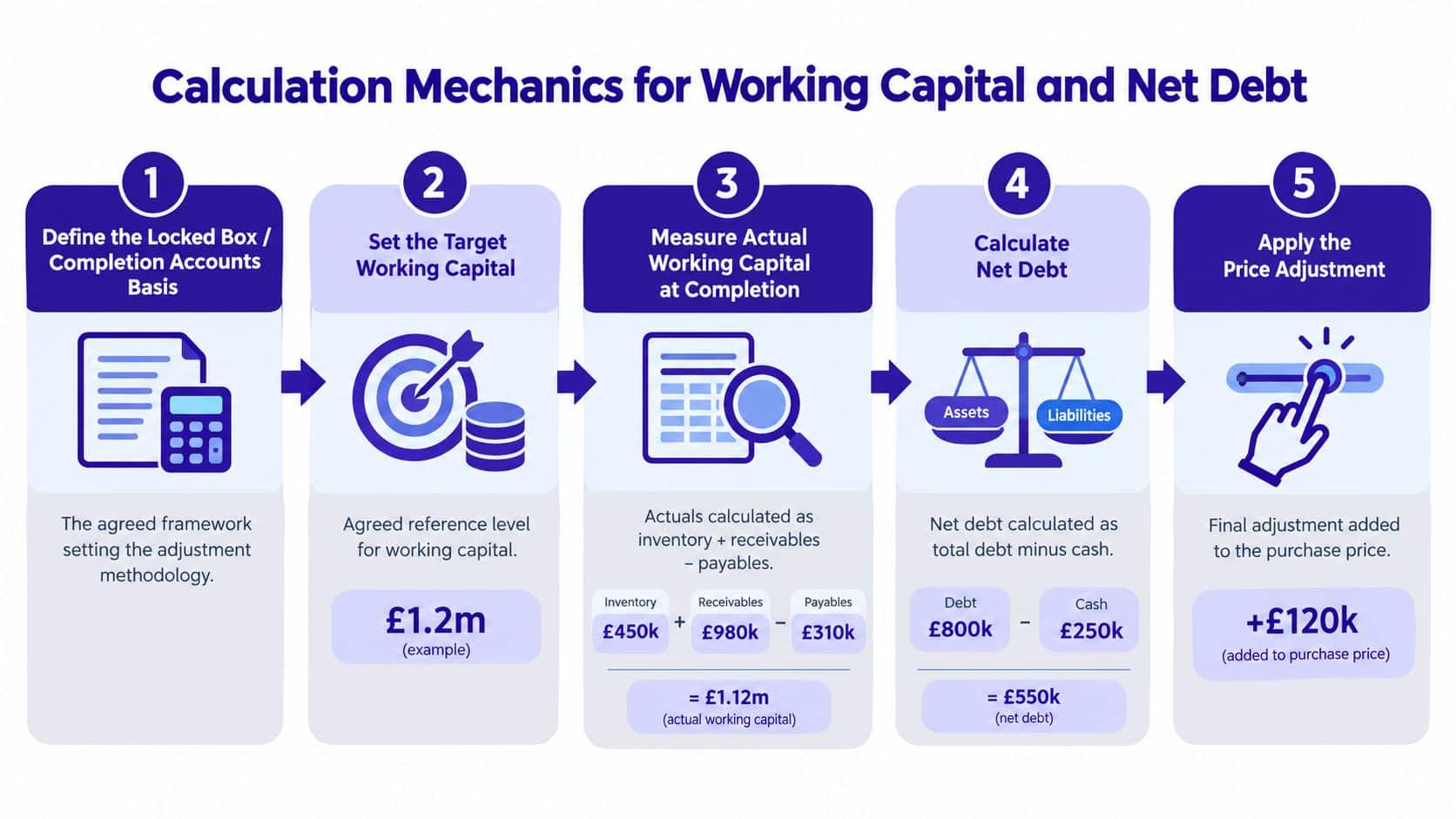
A completion accounts adjustment is not just a subtraction from a headline number. It is a controlled accounting exercise in which the parties must identify the correct entities, measurement date, account populations and policies before calculating the result.
The agreed working capital target, often called the peg, represents the operating level assumed in the negotiated price. The target should reflect the business that the buyer expects to acquire, including the normal level of inventory, receivables and payables required to operate it. A target derived from inconsistent periods or unusual balances can make the true-up measure accounting noise rather than a genuine change in value.
Establishing the measurement basis
A finance team should prepare an account-level bridge rather than rely on broad ledger headings. The analysis should identify:
- Receivables: Test ageing, recoverability, credit notes, disputed invoices and balances collected after completion.
- Inventory: Examine costing, stock counts, damaged goods, slow-moving items and obsolescence provisions.
- Payables: Reconcile supplier statements, unrecorded invoices, goods received not invoiced and cut-off.
- Accruals: Determine whether the liability relates to ordinary operations, the transaction or a pre-completion event.
- Deferred income: Assess whether the buyer must perform the service after completion and whether the agreed methodology reflects that obligation.
- Intercompany balances: Establish whether balances are included, settled, waived or treated elsewhere in the formula.
Completion accounts commonly focus on cash, debt and working capital, with a pound-for-pound true-up. A shortfall against the target working capital or net asset position reduces the price, while a surplus increases it, as explained in this guide to locked-box and completion accounts.
Net debt requires equal discipline. Borrowings and accrued interest may be obvious deductions, but finance leases, shareholder loans, unpaid transaction expenses, deferred consideration and certain tax or bonus liabilities can require specific treatment. Cash may also need adjustment for restricted balances, deposits, outstanding payments or funds held outside the acquired group.
The central control is consistency. If the working capital target included an accrual, the completion calculation should not remove that accrual from the closing balance without reflecting the effect in the target. If a debt-like item was excluded from the target, it shouldn't be left inside working capital. The same liability must not produce two deductions, nor should an item be omitted because its ledger label is inconvenient.
A separate schedule should reconcile the reported trial balance to the SPA categories. That schedule should show the source ledger, proposed classification, contractual basis, supporting evidence and financial effect. This format gives the board and advisers a clearer basis for negotiation than a spreadsheet containing unexplained reclassifications.
The working capital adjustment service is relevant where a party needs the peg analysed, the accounting basis tested, the adjustment quantified or evidence prepared for negotiation, expert determination or court proceedings.
Drafting Pitfalls and Accounting Policy Hierarchies
The most expensive completion accounts disputes often begin before completion. A clause may use familiar terms such as “consistent with past practice” or “in accordance with generally accepted accounting principles”, yet fail to explain which rule controls when those standards point in different directions.
A common completion-accounts hierarchy puts specific SPA policies first, historical accounting practice second and the agreed accounting standards third. Some agreements qualify historical consistency by compliance with those standards. BDO explains both approaches. Read the actual hierarchy: the order can change an item’s treatment and the final equity value.
Where drafting creates avoidable disputes
A detailed schedule should deal expressly with:
- Included accounts: Identify the ledger categories that form part of working capital.
- Excluded accounts: List cash, debt, taxes, transaction expenses and other excluded items.
- Accounting policies: State the method for provisions, stock valuation, revenue recognition and cut-off.
- Historical consistency: Identify which past practices matter and whether they apply only where the SPA is silent.
- Measurement date: Prevent one item being measured before completion and another after closing entries.
- Duplicate treatment: Explain how an item is handled if it could fall into more than one category.
- Post-completion conduct: Exclude changes caused only by purchase accounting or decisions made after the measurement time.
A general reference to accounting standards won't necessarily solve a dispute. Standards can permit judgement, while historical accounts may contain practices that the parties priced into the transaction. If the agreement doesn't state the priority, each side may select the interpretation that produces the more favourable price.
A balance-sheet label is evidence of bookkeeping, not a conclusive answer to a contractual classification.
Locked-box drafting has a different weakness. “Leakage” should be defined with enough precision to identify prohibited value transfers and permitted payments. Related-party charges, dividends, management fees, bonuses, asset transfers and debt releases should be addressed rather than left to broad wording that invites argument.
The SPA should also include an illustrative calculation using the negotiated definitions. The example should show how zero balances, negative numbers, disputed items and omitted accounts are treated. It should identify who prepares the first draft, the timetable for review, the form of a notice of disagreement and the authority of the decision-maker.
Completion accounts aren't self-executing. The agreement must establish the accounting policies, included and excluded items, preparation responsibility, review timetable and dispute-resolution process. Clear drafting cannot remove every judgement, but it narrows the field of disagreement and gives an expert a stable framework to apply.
Hypothetical Worked Example of a Completion Dispute
The following is a hypothetical example, not a client case. It illustrates how two classifications can move the price and why the parties need account-level evidence rather than assertions based on management intent.
A UK target is sold under a completion accounts mechanism. The SPA defines working capital as ordinary operating current assets less ordinary operating current liabilities, excluding debt, cash and transaction expenses. It requires the specific SPA policies first, historical consistency second and generally accepted accounting principles only after those rules.
The buyer's draft includes a provision for slow-moving inventory as a reduction to working capital. It also excludes an accrued management bonus from working capital and treats it as a debt-like item. The seller objects to both entries. The seller argues that the inventory has historically been sold at a margin and that the bonus is an ordinary payroll accrual already reflected in the working capital target.
Testing the inventory classification
The forensic review should start with the stock ledger, count records, ageing reports, subsequent sales and credit notes. It should then compare the proposed provision with the SPA's inventory policy and the treatment used in the accounts that informed the peg.
If the agreement requires a documented provision for stock that is unlikely to sell at its recorded cost, the buyer may have a strong basis for the adjustment. If the historical accounts consistently carried the same category without a provision and the SPA gives that historical treatment priority where the specific policy is silent, the seller may have a stronger position. The answer depends on the agreed hierarchy and the evidence, not on which party first identified the issue.
Testing the accrued bonus
The bonus requires a different analysis. The records should establish who earned it, the period to which it relates, whether it was triggered before completion and whether the target calculation already included comparable payroll accruals. Payroll reports, board approvals, employment terms, payment records and the prior-year accrual methodology can all be relevant.
If the SPA excludes transaction-related or change-of-control payments from working capital and treats them as debt-like, apply that agreed classification. A recurring bonus included in the peg should be compared on a consistent basis. Reclassifying a liability from working capital to debt does not, by itself, deduct it twice: the working-capital movement may offset the debt deduction. Double counting arises if the same liability is deducted through both the working-capital adjustment and the net-debt calculation without an agreed offset. Reconcile the peg, closing balance and price bridge before quantifying the effect.
The parties should prepare a notice of disagreement that identifies each item, the disputed amount, the alternative treatment and the contractual provision relied upon. Undisputed lines should be accepted separately so that the dispute remains focused on the genuine accounting questions.
The resolution may therefore produce three outcomes:
- Inventory provision accepted, bonus retained in working capital. The buyer receives the stock adjustment but not a second deduction for the bonus.
- Inventory provision rejected, bonus treated as debt-like. The seller receives credit for the agreed stock basis, while the bonus reduces the price under the debt definition.
- Both treatments modified. The expert may apply a contractual policy that differs from the original draft, provided the mandate permits that decision.
The practical lesson is to test each disputed line against the SPA and supporting records. Inventory provisions and bonus accruals can require different evidence and may produce different conclusions. For wider context, Goodwin’s March 2023 comparison of UK and US deal terms explains completion-account and locked-box mechanisms. It does not determine the classification in this hypothetical example.
Dispute Resolution and Appointing an Expert Witness
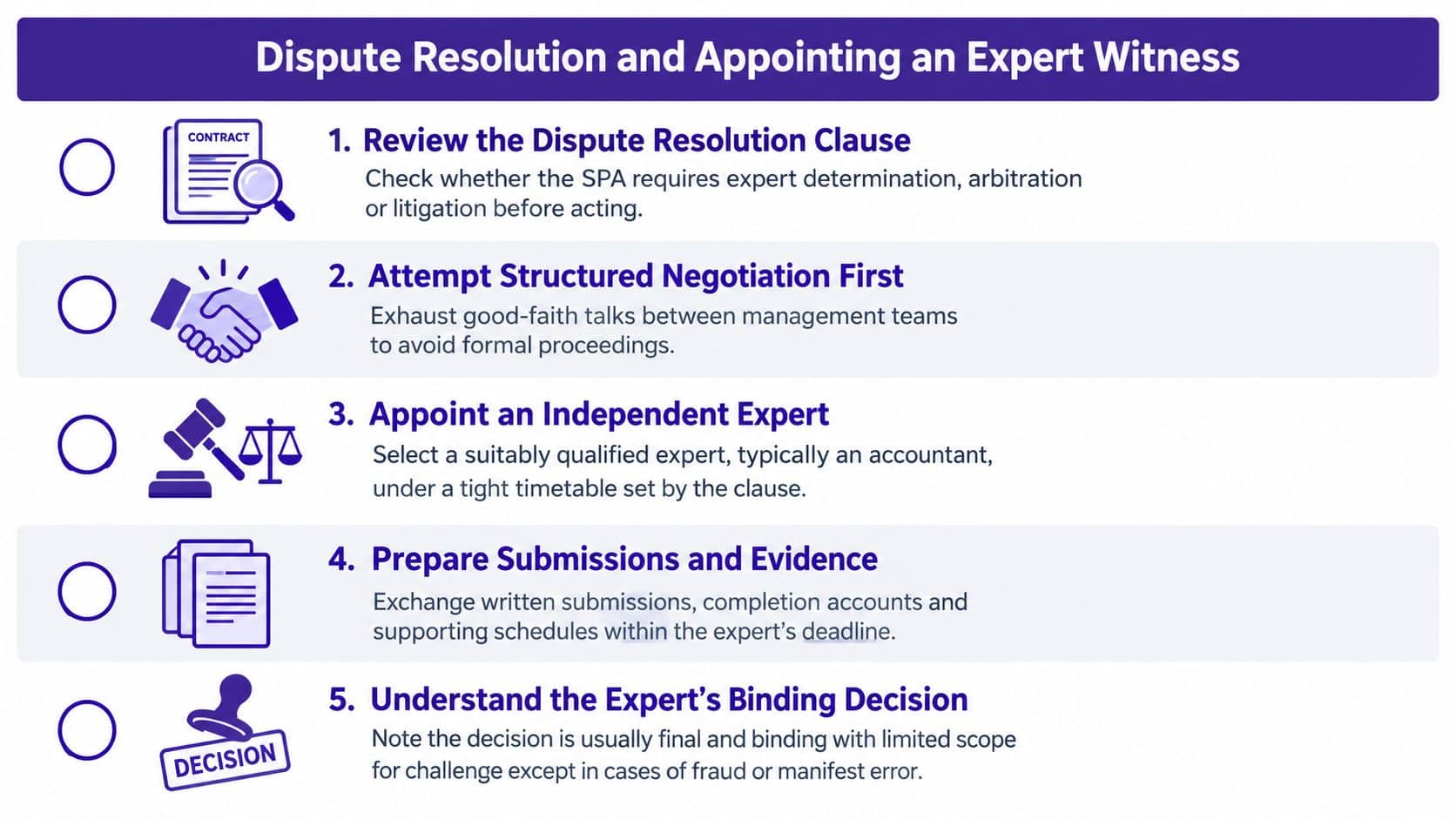
The SPA should be read before any objection is prepared. It may require management negotiation, an independent expert determination, arbitration or court proceedings, and the wrong route can waste time or place a submission outside the decision-maker's authority.
An independent accountant usually works within a narrow contractual mandate. The expert may be authorised to decide specific accounting calculations, but not to rewrite the SPA, determine unrelated warranty claims or introduce a new accounting basis. Whether a decision is final and binding, and how far a court can review it, depends on the language of the agreement and the nature of the authority granted.
Preparing a defensible submission
The strongest submissions separate accounting evidence from contractual argument. A working file should ordinarily preserve:
- The SPA and schedules: Include the accounting hierarchy, definitions, formula and dispute clause.
- Completion accounts: Keep every version, including the first draft and amended schedules.
- General ledger evidence: Retain trial balances, account transactions and journal support.
- Operational records: Preserve stock reports, receivables ageing, supplier reconciliations and payroll data.
- Management explanations: Record who provided each explanation and when.
- Reconciliation schedules: Show how the ledger reaches each disputed line in the price calculation.
The notice of disagreement should avoid broad objections such as “the accounts are wrong”. It should state the exact line, the amount in dispute, the proposed alternative and the relevant SPA provision. An independent expert can then address the defined questions instead of reconstructing the entire transaction.
An accountant advising a party, an independent expert deciding an SPA dispute and an expert witness giving evidence have different roles. Agree the role, mandate and reporting purpose before instruction. Our expert witness testimony service may be relevant where accounting opinion evidence is needed in proceedings. The court expert’s overriding duty is to the court, rather than the party paying the fees; see Civil Procedure Rule 35.3.
The following video provides general visual context on the role of expert evidence in disputes.
An expert should remain independent, even when instructed by one party. Confidentiality should be addressed at the outset, including who may receive working papers, how commercially sensitive records are transferred and whether the engagement is advisory or intended to support formal proceedings. Cost depends on the scope, records, timetable, complexity and forum, so a staged review can help the board decide whether a full expert report is proportionate.
The SPA should identify the accounting policies, included and excluded items, preparation responsibility, timetable and dispute route. A forensic review cannot rewrite a missing contractual definition. However, it can show how different interpretations affect the calculation and identify which records support each position. Legal advisers should address questions about contractual meaning and the permitted dispute process.
Strategic Next Steps for Finance Directors and Solicitors
Finance directors and solicitors can reduce post-completion friction by testing the price mechanism before signing, not after the first disputed schedule arrives. The review should use the target's actual ledger and operating records, with the proposed definitions applied account by account.
A practical pre-signing checklist includes:
- Stress-test the peg: Compare the proposed target with seasonal balances, recent trading patterns and the operating capital the buyer will need.
- Map every disputed category: List receivables, inventory, provisions, accruals, deferred income, taxes, intercompany balances and transaction expenses.
- Check for duplication: Trace each debt-like item and transaction cost through working capital, net debt and the funds flow.
- Agree the hierarchy: Confirm whether SPA policies, historical consistency or generally accepted accounting principles control when treatments conflict.
- Attach an illustration: Show the formula, account populations, negative numbers, zero balances and possible disputed classifications.
- Preserve evidence: Secure ledgers, reconciliations, stock records, payroll information, bank statements and post-completion collection data.
- Define the escalation route: Confirm the objection timetable, expert authority, confidentiality arrangements and consequences of missed deadlines.
The board should also decide who needs access to sensitive records and whether an independent review is required before negotiations begin. A tightly scoped forensic engagement can focus on the peg, selected classifications or the entire adjustment, depending on the value and complexity of the dispute. The resulting work should distinguish factual findings, accounting judgements, contractual assumptions and unresolved limitations.
Lighthouse Consultants provides forensic accounting and financial analysis for complex transactions and disputes, including analysis of working capital adjustments and evidence preparation for negotiation, expert determination or court. The scope, records, independence requirements and reporting purpose should be agreed before work starts, so the engagement remains proportionate to the issue.
For a free consultation about a purchase price adjustment, call +44 20 7871 0485 or email info@lighthc.london. Discuss the disputed classifications, available records and contractual timetable so that a focused review can be scoped.