Ever been blindsided by an unexplained financial loss, a sudden compliance fine, or a critical operational failure? Too many leaders find themselves stuck in a cycle of just putting out fires. They’re dealing with costly legal battles, reputational damage, and stalled growth after the damage has already been done. This constant crisis mode is exhausting and, frankly, completely avoidable. Trying to navigate today’s market without a proactive risk assessment framework is like sailing into a storm without a compass—it’s not a matter of if you’ll go off course, but when.
Overcoming the Hurdles to Action
We often hear from leaders that building a proper framework sounds too complex or expensive. The thinking is that their teams just don’t have the time or specialist knowledge, so it gets pushed down the road to ‘later’. Another worry is that a framework will just create more red tape and slow everything down. This view, however, misses the very real, and often hidden, costs of doing nothing. The resources you spend reacting to a single major incident—like a data breach or regulatory penalty—will almost always dwarf the investment in a proactive framework. You can learn more about the hidden costs of financial risk in our detailed guide.

The Strategic Advantage We Deliver
A well-designed system actually does the opposite of creating red tape. It clarifies who is responsible for what, sets clear rules for assessing threats, and gives your team the confidence to act decisively. It swaps ambiguity and guesswork for structured, clear-headed analysis. At Lighthouse Consultants, we excel at turning this daunting task into a logical, manageable process. We help you build a practical system that prevents losses, not one that just sits on a shelf collecting dust. We help you turn risk from a source of anxiety into a well-managed part of your business strategy.
Our process empowers you to:
- Identify vulnerabilities before they turn into expensive crises.
- Prioritise threats based on their genuine impact on your goals.
- Develop clear action plans to mitigate, transfer, or accept risks with full awareness.
- Embed a culture of risk awareness across your entire team.
Let us handle the complexities of financial and operational risk so you can get back to leading your organisation with confidence. Schedule a complimentary discovery call with our experts today and take the first step toward building a more secure and resilient future for your business.
Understanding Your Risk Assessment Framework
Let’s cut through the jargon. For many business leaders, the phrase “risk assessment framework” conjures up images of endless paperwork and processes so complex only a specialist could understand them. This is a common misconception, but it’s one that often leads to doing nothing at all, leaving businesses wide open to threats that could have been managed. The real problem isn’t the framework itself; it’s the paralysis that sets in when you don’t know where to start. It feels huge, and the fear of doing it wrong often means it never gets done.
Facing Common Concerns Head-On
You might be thinking, “We don’t have the expertise for this,” or perhaps, “Isn’t this just for giant corporations?” Maybe you’re worried that a formal risk assessment framework will just create red tape and slow your team down. These are perfectly valid thoughts. But operating without a structured way to handle risk is like building a house without a blueprint. It might look fine for a while, but it won’t have the foundations to survive a storm. The cost of cleaning up after a crisis always outweighs the effort of preparing for one.
At Lighthouse Consultants, our job is to strip away that complexity. We see a strong framework not as a rigid set of rules, but as your company’s own operating system for handling uncertainty. It’s there to bring clarity, empower your team to make smarter decisions, and help you see risk not just as a threat, but as a manageable part of your strategy. We boil it all down to four essential pillars, making the process straightforward for everyone from business owners to finance directors. This structure helps you build a solid foundation that can handle whatever comes your way. A full understanding of your framework often connects with broader strategies like Enterprise Risk Management, which can turn uncertainty into a real strategic advantage.
The Four Pillars of a Strong Framework
Let’s walk through the four pillars with some simple, real-world examples:
1. Risk Identification: What Could Go Wrong?
This is where it all begins: brainstorming potential threats. Don’t just think about cyber-attacks or financial trouble. This includes everything from operational hiccups to something damaging your reputation.
- Example: A retail business might identify a “supply chain disruption,” where a key supplier suddenly folds, stopping products from reaching shelves. Another risk could be a “data breach” that leaks customer information.
2. Risk Analysis: How Bad Could It Be?
Once you’ve listed your risks, you need to figure out how serious each one is. This means looking at two things: how likely it is to happen, and what the fallout would be if it did.
- Example: For the supply chain risk, the likelihood might be ‘Possible’ (a 3 out of 5), but the impact would be ‘Major’ (a 4 out of 5) because it would bring sales to a halt. This gives you a clear sense of how big the threat is.
A risk framework isn’t a document you create once and then file away. Think of it as a living system that grows with your business, helping you see change coming and act with confidence, not fear.
3. Risk Evaluation: What Do We Tackle First?
You can’t fix everything at once, and not all risks are equal. This pillar is all about prioritising. Based on your analysis, you decide which risks need immediate attention and which ones you can simply keep an eye on.
- Example: That high-impact supply chain risk would definitely be prioritised over a lower-impact risk, like a minor website glitch that’s unlikely to happen anyway.
4. Risk Treatment: What’s Our Plan of Action?
Finally, for each of your high-priority risks, you come up with a plan. There are generally four ways to handle a risk:
- Mitigate: Reduce its likelihood or impact. For instance, you could vet and onboard a backup supplier.
- Transfer: Shift the risk to someone else. A common example is buying business interruption insurance.
- Accept: Acknowledge the risk but decide to do nothing, which usually makes sense for minor threats.
- Avoid: Get rid of the risk entirely by stopping the activity that causes it, like discontinuing a product with a very unstable supply chain.
When you break it down like this, building a risk assessment framework stops being overwhelming and becomes a logical, manageable task. The goal isn’t to eliminate every single risk—that’s impossible. It’s about understanding them so you can lead with foresight and stay in control. At Lighthouse Consultants, we guide businesses through each of these pillars, helping you build a framework that protects what you’ve built and supports your growth. Ready to create your blueprint for resilience? Schedule your complimentary discovery call today.
How to Build Your Framework Step by Step
Let’s be honest: the idea of building a risk assessment framework from scratch can feel overwhelming. Many business leaders imagine a massive, bureaucratic project that will swallow up time and resources they simply don’t have. So, it gets pushed to the bottom of the list.
From Hesitation to Action
But this hesitation is exactly what leaves a business vulnerable. You might be thinking, “My team is already stretched thin,” or “We don’t have the budget for a dedicated risk department.” These are completely valid concerns. The thing is, reacting to a crisis after the fact is always far more expensive and chaotic than preparing for one beforehand. And a powerful framework doesn’t have to be complicated. At Lighthouse Consultants, we excel at turning this daunting task into a logical, manageable process. We help you build a practical system that actually prevents losses, not one that just sits on a shelf collecting dust. It all starts with a complimentary discovery call where we listen to your unique challenges and then map out a clear plan to put you back in control.
This visual breaks down the simple, four-step process for creating an effective risk framework.
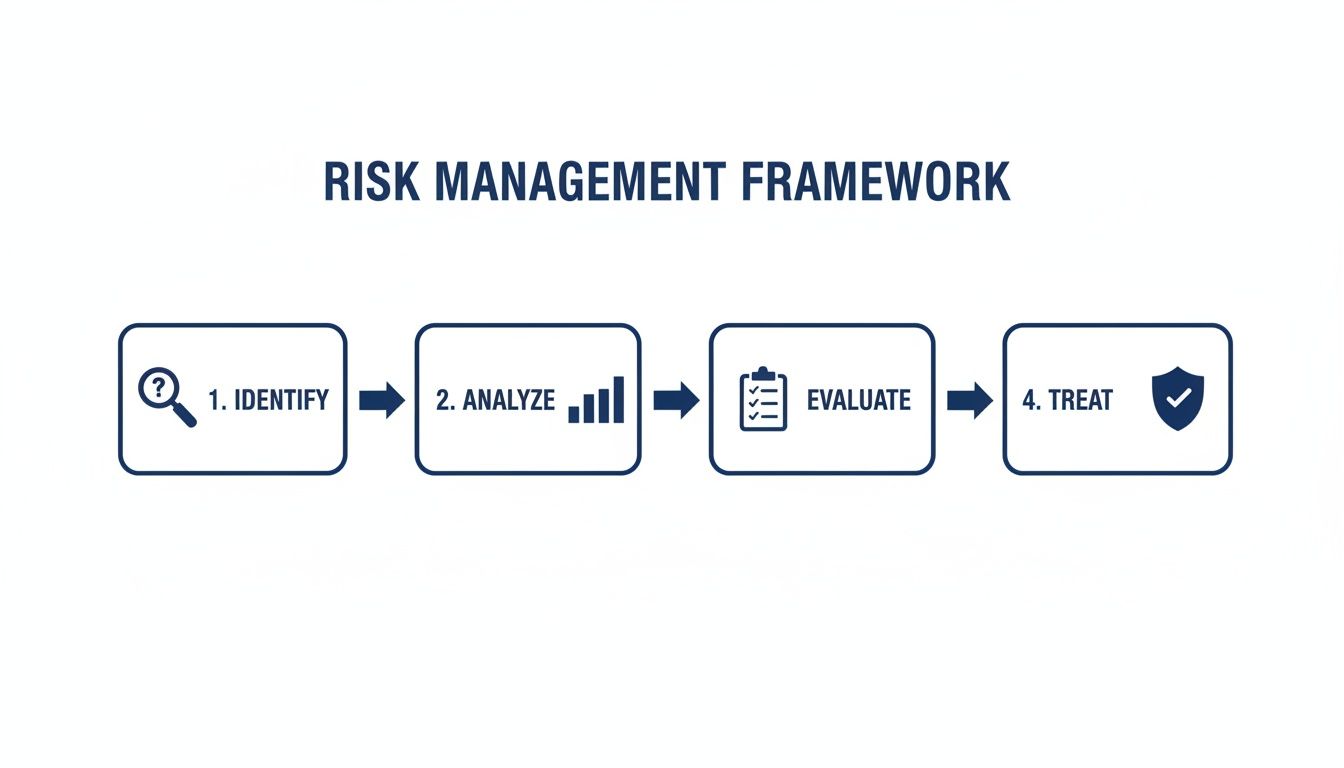
This approach takes the mystery out of risk management, breaking it down into a clear sequence: identify, analyse, evaluate, and treat.
Step 1: Define Your Objectives and Scope
Before you can spot a single risk, you need to know exactly what you’re protecting. Start by defining the framework’s core objectives. Are you aiming to prevent financial fraud, secure your supply chain, or nail down regulatory compliance? The more specific you are, the better. A sharp, clear objective ensures your framework is aligned with your most critical business goals. Next, establish the scope. Will this framework cover the entire organisation, a single department, or one vital project? Often, it’s best to start small. A focused scope, like securing your IT infrastructure, can make the process far more achievable and deliver some quick, confidence-boosting wins. For those focused specifically on digital defences, a detailed guide on building robust cybersecurity risk management frameworks offers an excellent blueprint.
Step 2: Create a Practical Risk Register
Your risk register will become the central nervous system of your framework. Think of it as your master list of everything that could potentially go wrong. It doesn’t need to be fancy software; a straightforward spreadsheet is usually the best place to begin. For every risk you identify, your register should capture a few key details: a clear description of the risk (e.g., “Key supplier for Component X goes out of business”), the potential impact this would have on the business, the likelihood of it actually happening, and the person or department responsible for managing it.
A risk register isn’t just a list of worries. It’s an accountability tool that assigns clear ownership, ensuring someone is actively monitoring each potential threat before it can escalate into a full-blown crisis.
Step 3: Establish Clear Evaluation Criteria
Once you have your list of risks, you need a consistent way to sort them. The most effective method is a simple impact versus likelihood matrix. This tool helps you visually map out which risks need your immediate attention and which ones can wait. You can create a simple 3×3 grid or a more detailed 5×5 version depending on your needs. History shows us just how powerful structured evaluation can be. After the Health and Safety at Work Act 1974 mandated formal risk assessments, fatal workplace accidents dropped by 17% by 1980. Fast forward to 2023, and HSE statistics show that proper assessments have helped avert an estimated 60% of potential major incidents in high-risk industries, proving their financial sense.
Step 4: Develop Decisive Risk Treatment Plans
Finally, for each high-priority risk, you need a clear plan of action. There are four main strategies for dealing with a threat, which you can read about in our guide covering the four risk management steps.
- Mitigate: Take practical steps to reduce the risk’s likelihood or its potential impact.
- Transfer: Shift the financial fallout to someone else. The most common example is buying business interruption insurance.
- Accept: Acknowledge the risk but decide that the cost of doing anything about it outweighs the potential damage.
- Avoid: Completely stop the activity that creates the risk in the first place.
By following these steps, you can move from worrying about risks to actively managing them. Let Lighthouse Consultants guide you through this process with expert precision. Contact us today to create a framework that protects your organisation and clears the way for growth.
Putting Risk Frameworks into Real-World Practice
You’ve invested time and money building what looks like a solid risk assessment framework. But when you search for the real-world results—fewer disruptions, better financial control, smarter decisions—you’re left empty-handed. It’s a common and deeply frustrating place for many leaders to be.
The Problem with Generic Frameworks
The problem is that a generic, off-the-shelf strategy rarely delivers. You might worry your framework is just another document gathering dust, far too theoretical to make a genuine difference. Perhaps you suspect it isn’t truly aligned with the unique pressures of your industry, leaving you exposed when real challenges hit. At Lighthouse Consultants, we shift risk management from a theoretical exercise to a practical, results-driven advantage. We specialise in building frameworks that aren’t just robust on paper but are proven to deliver measurable outcomes in your specific sector. We start with a complimentary discovery call to understand your world, then deliver a clear, scoped action plan designed for real impact.
From Theory to Tangible Results
A truly effective risk assessment framework is never generic; it must be meticulously adapted to the environment it operates in. What works for a retail logistics firm will be completely inadequate for a public sector healthcare provider. The key is to tailor every element—from how you identify risks to how you treat them—to the precise vulnerabilities and goals of your organisation. When a framework is properly customised, it becomes a powerful tool for driving performance and ensuring stability. Let’s look at how two major UK organisations have applied this principle to achieve significant, measurable success.
Case Study: The NHS Financial Viability Model
The National Health Service (NHS) uses a sophisticated financial risk model called the Risk Assessment Framework (RAF) to monitor the health of foundation trusts and prevent service failures. Oversight revealed that trusts flagged with higher risk ratings had a 35% greater chance of running financial deficits. Following RAF-driven interventions, sector-wide deficits were cut by 22% by 2018. More recently, in 2023, the framework’s governance triggers flagged issues in 18 trusts, leading to £300 million in recovered funds through renegotiated contracts. You can find more details about these findings in the official government publication. This example proves how a well-implemented framework can drive financial recovery and safeguard essential services.
A tailored risk framework acts as an early warning system. It doesn’t just identify problems; it provides the data and triggers needed to take decisive action before a risk escalates into a full-blown crisis.
Case Study: The Food Standards Agency’s Supply Chain Resilience
The Food Standards Agency (FSA) offers a powerful example of adapting a risk framework to new and emerging threats. Following Brexit, the FSA had to manage new vulnerabilities in the supply chain. They adapted their existing framework to specifically target these new risks, with a heavy focus on preventing food fraud and ensuring the integrity of goods entering the country. This proactive adaptation yielded impressive results. It led to a significant reduction in high-impact food fraud incidents, helped safeguard billions in potential annual retail losses, and significantly improved response times to supply chain incidents. These case studies provide concrete proof that a risk assessment framework tailored to your industry’s unique challenges delivers tangible results.
Ready to stop guessing and start implementing a framework that truly works for you? Contact Lighthouse Consultants today for a complimentary discovery call and let our experts build the resilient financial future your organisation deserves.
Common Pitfalls and How to Avoid Them
You’ve built the framework. You’ve documented everything. So why does it feel like it’s failing? If you’re not seeing tangible results—fewer disruptions, better financial control, smarter decisions—you’re not alone. The framework that was meant to be a protective shield ends up feeling more like a theoretical exercise, a document gathering dust on a server. You start to suspect it’s just a tick-box compliance tool, not a living system that actively protects your organisation. This is the single biggest reason frameworks fail to deliver.

From Static Document to Dynamic Defence
The most dangerous pitfall is treating your risk assessment framework as a one-and-done project. Threats evolve, markets shift, and new vulnerabilities emerge constantly. A framework created last year might be completely blind to today’s most significant risks. Just look at the Food Standards Agency (FSA). After leaving the EU, the FSA implemented a new Risk Analysis Process in 2018. This allowed it to handle over 250 novel risks in 2021 alone. This proactive approach cut high-impact food fraud incidents by 28% between 2019 and 2023, safeguarding an estimated £4.5 billion in annual retail losses. You can discover more about the FSA’s risk assessment success on food.gov.uk.
Lack of Cultural Integration
Another common failure point is a lack of cultural buy-in. If risk management is seen as just one department’s job, it will never be truly effective. When teams on the ground don’t understand their role in spotting and managing risks, your framework becomes disconnected from reality. To avoid this, risk awareness has to be embedded into your company culture. This means providing regular training, sharing insights and successes from your risk management activities, and assigning clear ownership for each identified risk, making it a genuine part of individuals’ roles.
Overcoming Inertia with Expert Guidance
We understand these challenges because we see them every day. Perhaps your team lacks the time or specialised knowledge to maintain a dynamic framework, or you’re struggling to get buy-in across the organisation. This is where an expert partner makes all the difference. At Lighthouse Consultants, we transform your framework from a passive document into an active, strategic tool. We help you establish continuous monitoring, drive cultural change, and deliver actionable insights. Don’t let your investment in a risk assessment framework go to waste. Schedule your complimentary discovery call today, and let us help you build a resilient system that actively protects your organisation’s future.
Why Expert Guidance Matters for Your Risk Framework
You understand the idea behind a risk assessment framework, but turning that theory into something that actually works is where so many organisations get stuck. Perhaps you’ve tried to build one internally, but it feels more like a box-ticking exercise than a real defence. It just sits on a server, totally disconnected from the day-to-day operational pressures your teams face, and fails to deliver the security you thought you had. This is a common and deeply frustrating gap between good intentions and a poor outcome.
Addressing the Expertise Gap
You might be thinking, “we just don’t have the specialised skills for this,” or “our team is far too busy to manage it properly.” These are valid concerns. An improperly built framework isn’t just ineffective; it creates a false sense of security, leaving your organisation exposed to the very financial and operational threats you assumed were covered. A generic template simply can’t account for the unique pressures of your industry or the scrutiny it might face in a dispute. This is where Lighthouse Consultants brings critical value. We transform your risk assessment framework from a static document into a powerful, active shield for your business.
Our Expert-Led Solution
Our Chartered Management Accountants don’t just offer generic advice. We deliver forensic-level risk assessments and internal audits tailored to your sector’s unique challenges. We provide the expert oversight needed to ensure your framework is not just compliant, but genuinely effective. Our process is designed for clarity and control, removing the burden from your internal teams. A framework built by our experts is designed to do more than just identify threats; it’s constructed to withstand intense scrutiny in negotiations, disciplinary hearings, and even in court. It provides an authenticated, objective foundation for your decisions.
A Controlled and Transparent Process
We understand that you need results, not more complexity. That’s why we have a straightforward and controlled process that puts you in the driver’s seat from day one. It begins with a complimentary discovery call where we listen to your specific needs. Following that, we deliver a clear, detailed action plan with precise steps and timelines. Throughout the engagement, we provide regular, easy-to-understand reports, so you always have a clear view of our progress. If you’re ready for a more robust approach, explore our insights on how we can help with risk assessments. Stop letting risk management be a source of anxiety. Schedule a complimentary discovery call with Lighthouse Consultants today and let our experts build the resilient financial future your organisation deserves.
Frequently Asked Questions
When you’re building a resilient organisation, the path to a working risk assessment framework can feel cluttered with questions. Many leaders I speak to are hesitant to start, worrying about the time it will take or if they’re even asking the right questions. This uncertainty often leads to doing nothing at all, which leaves the business exposed.
Answering Your Key Concerns
You might be thinking, “How can I justify the resources when we’re already stretched?” or “What if we build a framework and it doesn’t actually work?” These are perfectly valid concerns. A poorly built framework is arguably worse than having none, as it creates a false sense of security while eating up time and budget. The answer isn’t just to build any framework; it’s to build the right one, grounded in how your business actually operates. We’ve put together answers to some of the most common questions we hear from clients.
| Question | Answer |
|---|---|
| How Long Does Implementation Take? | This really depends on the size and complexity of your organisation. A smaller business might get a solid foundation in place within a few weeks. A larger enterprise, on the other hand, could be looking at a three to six-month project for full integration. The trick is to start with a focused scope and build out, rather than trying to solve everything at once. |
| What’s the Difference Between a Risk Assessment and a Risk Framework? | It’s vital to distinguish between these two. A risk assessment is a specific task, like analysing the risk of bringing on a new supplier. In contrast, the risk assessment framework is the entire system—the policies, processes, tools, and culture—that your organisation uses to consistently carry out those assessments. Think of it as the strategic blueprint for all your risk activities. |
| How Often Should a Risk Framework Be Reviewed? | Your risk framework needs a formal review at least annually. But it’s not a “set it and forget it” document. It must be updated whenever your business goes through significant change—entering a new market, launching a product, or facing new regulations. A good risk framework is a living system, not a one-off project. |
Hopefully, these answers provide some clarity. The goal is to move from uncertainty to confident, strategic action. At Lighthouse Consultants, our Chartered Management Accountants take the guesswork out of the process. We don’t just build templates; we deliver forensic-level assessments that turn risk management into a genuine strategic advantage, giving you the clarity and confidence to lead.
Ready to transform your approach to risk? Schedule your complimentary discovery call with us today.
Crafted with Outrank app